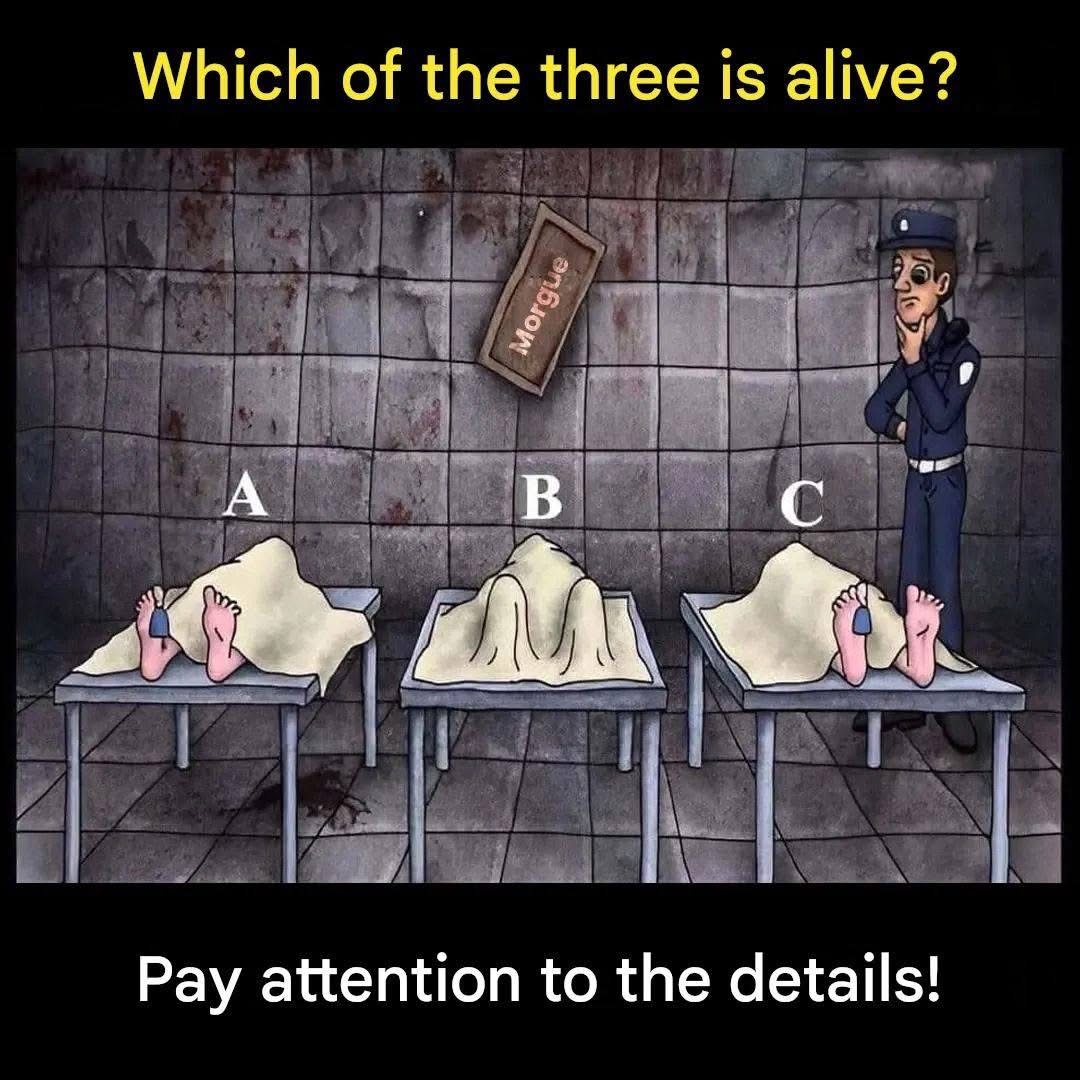
At first glance, the image looks simple. Three bodies lie on metal tables inside a morgue, each labeled A, B, and C. A police officer stands nearby, studying the scene. Everything feels still, cold, and final. But one detail changes everything. One of these three is not dead — and the answer isn’t obvious unless you slow down and really look.
Most people immediately focus on the feet. Two of the bodies have visible toes sticking out from under the sheets, while one is fully covered. That alone isn’t enough to solve it, though. The real trick in this puzzle is noticing what doesn’t belong in a morgue and what would only happen if someone were alive and reacting.
Look closely at body B. Unlike the others, the sheet is raised in a way that suggests tension rather than stillness. It doesn’t lie flat like it would over a lifeless body. There’s shape, resistance, and subtle movement implied beneath the fabric — something the other two lack. In a place meant for the dead, that difference matters.
Now compare the surroundings. Bodies A and C lie naturally, their feet relaxed and angled outward, exactly how muscles settle after death. There’s no sign of strain or discomfort. But body B looks different, as if the person underneath is holding themselves up or reacting to being covered. That kind of posture doesn’t happen when muscles are completely relaxed.
The final clue is psychological. Morgues are cold. Extremely cold. A living person would instinctively tense their body under a sheet, pulling inward for warmth or protection. A deceased body cannot do that. The raised sheet over B isn’t accidental — it’s a response.
That makes the correct answer body B.
This puzzle works because it forces you to ignore what you expect to see and focus on what feels slightly wrong. The smallest detail reveals the truth. And once you see it, you’ll never miss it again.
Leave a Reply