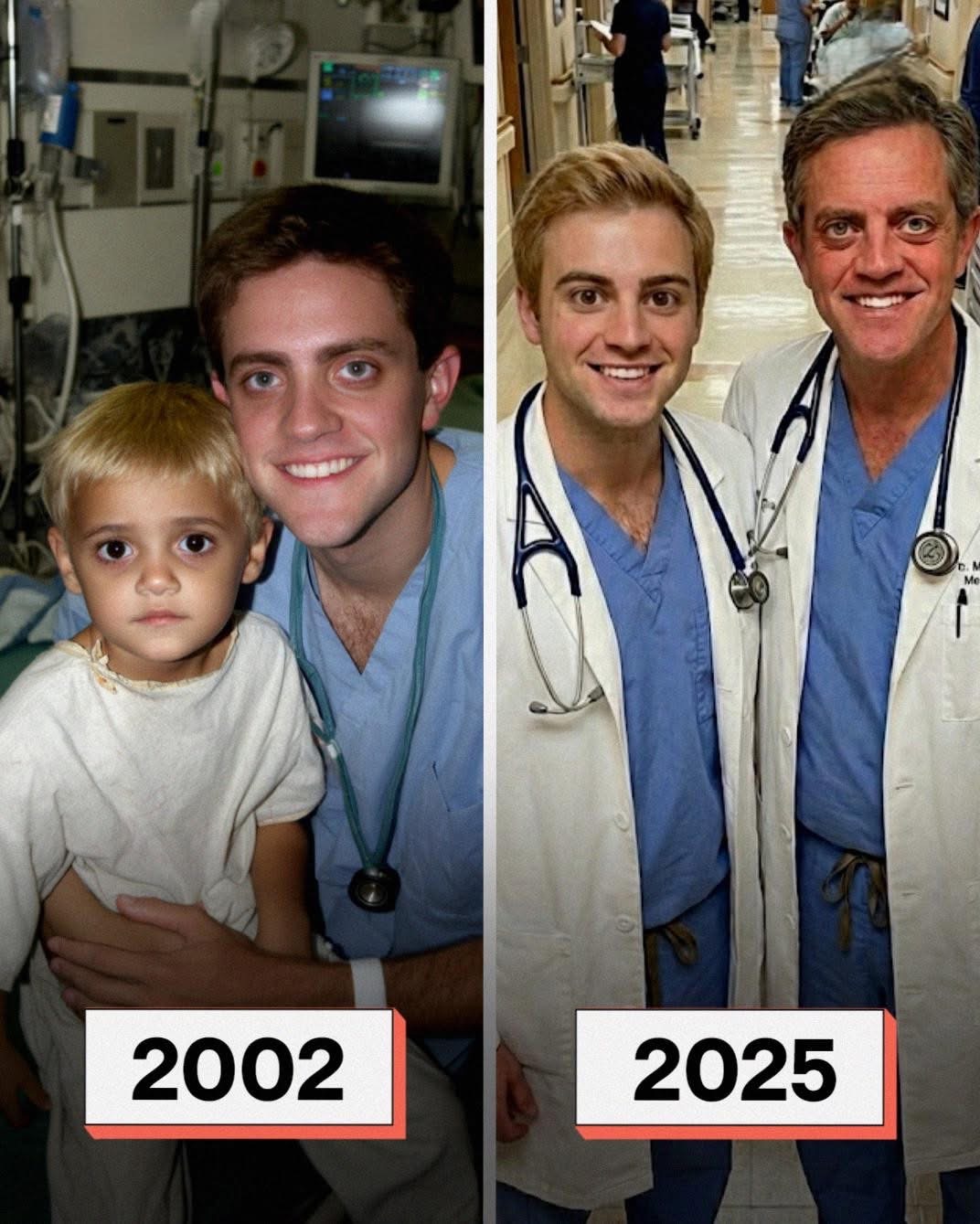
The woman’s hands shook as she stepped closer, her eyes never leaving Owen’s face. I felt something cold settle in my stomach before she even spoke again. “I never stopped thinking about you,” she said, tears spilling freely now. “I didn’t know if you lived. I didn’t know if the surgery worked.” Owen’s breath caught. He looked at me, then back at her, the realization crashing down in slow motion. This wasn’t just a stranger in the ER hallway. This was the mother who had signed papers and disappeared, leaving a six-year-old boy behind with nothing but stitches and a stuffed dinosaur.
Security hovered nearby, sensing the tension. I wanted to shield Owen, to step between him and the pain that should never have found him again. But he didn’t move. He stood tall, shoulders squared, not as an abandoned child, but as a doctor who had spent years learning how to face fear without flinching. “Why did you leave?” he asked quietly. No anger. Just truth. The woman collapsed into a chair, sobbing as she confessed everything—poverty, threats from creditors, a husband who vanished, the terror of hospital bills she could never pay.
“I thought you’d have a better chance if I disappeared,” she whispered. “I was wrong. I was a coward.” Nora squeezed Owen’s hand, her bruised face soft with compassion. “He did have a better chance,” she said gently. “But not because you left. Because love stayed.” The words landed like a verdict. The woman nodded, broken, accepting the weight of her choices. She didn’t ask for forgiveness. She didn’t ask for a place in his life. She only asked, “Are you happy?”
Owen answered without hesitation. “Yes. I’m loved. I became who I am because someone chose me when you couldn’t.” He glanced at me then, and I felt my chest tighten with a pride so fierce it hurt. The woman smiled through tears, whispering, “That’s all I ever hoped for,” before allowing security to guide her away. No scene. No shouting. Just closure that came twenty-five years late.
That night, after Nora was safely discharged, the three of us sat together in silence. Finally, Owen spoke. “I don’t hate her,” he said. “But she doesn’t get to rewrite my story.” He looked at us, his real parents, the ones who stayed for fevers, homework, heartbreak, and dreams. “You’re my family.” In that moment, I understood something profound: saving a life isn’t always about surgery. Sometimes, it’s about staying when others run.
And as I watched my son walk back into the hospital—confident, steady, whole—I realized the greatest miracle of my career wasn’t a successful operation. It was the child who was once abandoned… growing up to heal others, without ever abandoning himself.
Leave a Reply