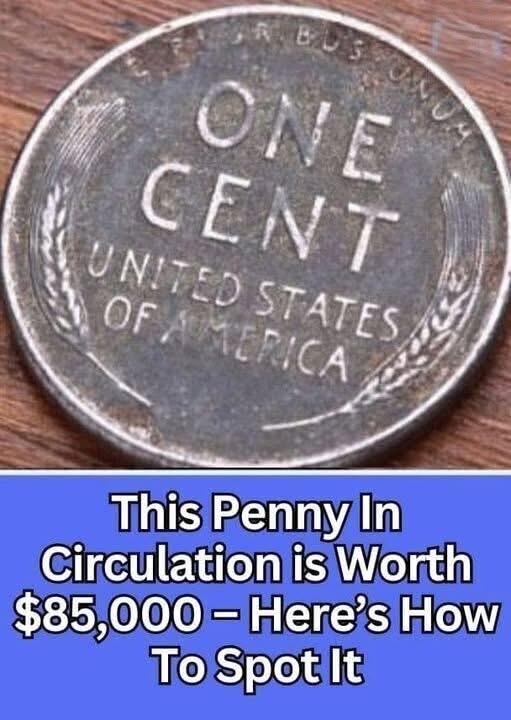
Most people toss spare change into a drawer, a jar, or a car cupholder without giving it a second thought. Pennies feel insignificant—too small to matter, too common to care about. But every once in a while, a single coin in that forgotten pile can be worth more than a month’s salary… or even a year’s. And among all American coins, few have achieved the almost legendary status of the 1943 copper wheat penny.
To understand why this tiny coin can sell for $60,000 to $85,000, you have to go back to a moment in history when the entire nation was under pressure. In 1943, during the height of World War II, the U.S. Mint was ordered to conserve copper for the war effort. Copper was essential for ammunition, wiring, and communication equipment—vital military supplies. Making pennies from copper was no longer acceptable.
So the Mint made a rare change: instead of copper, they produced pennies made from zinc-coated steel. These “steelies” look completely different—gray, shiny, and lighter than normal. It was the only year in history that pennies were made from steel.
In theory, no copper pennies should have been made in 1943.
But things don’t always go according to plan.
A few leftover copper blanks—the small discs used to make coins—were accidentally fed into the presses alongside the steel blanks. No one noticed, and the machines stamped them and sent them into circulation. What should have been an ordinary year suddenly turned historic, and those accidental copper pennies became some of the rarest coins in American history.
Only a handful exist. Experts estimate that fewer than 25 genuine 1943 copper pennies have ever been found.
That rarity sends collectors into a frenzy. A real 1943 copper penny in top condition can sell for around $85,000. Even one that’s worn, scratched, or dull still sells for about $60,000. For a single penny.
Think about that: a coin worth one cent could pay off debt, buy a car, or even help start a business—if you happen to find the right one.
Naturally, such value attracts counterfeiters. Where there’s money, there are fakes. And people unfamiliar with coins often fall for scams because the differences are subtle unless you know what to look for.
One common scam is turning a 1948 penny into a fake “1943” by reshaping the “8” to look like a “3.” To an untrained eye, it looks convincing.
Another scam involves coating a regular 1943 steel penny—the common gray one—in copper. It looks real at first glance: same size, same shine, same date. But underneath, it’s still steel. And steel behaves differently from copper.
Here’s the simplest test you can do: hold a magnet to the coin.
Copper isn’t magnetic.
Steel is.
If the coin sticks to a magnet, it’s fake—either a copper-coated steel penny or a manipulated coin. This quick test has saved collectors thousands of dollars.
Other methods exist—checking weight, analyzing metal content, or examining thickness—but the magnet test is the easiest for most people.
What many don’t realize is that countless old jars, inherited collections, and dusty attic boxes might hold one of these rare pennies without anyone knowing. People used coins so casually in the 1940s that many copper 1943 pennies entered circulation unnoticed. Some may have been tossed into drawers by returning soldiers. Others stayed hidden in wallets or old tins until their owners passed away.
If you inherited coins from relatives or have a jar of mixed change, it’s worth taking a closer look. Just check for:
• the date 1943
• a copper-colored surface
• no magnetic attraction
• the old wheat ear design on the back
If all these match, you might be holding something worth more than most of your belongings.
If your penny looks real and passes the magnet test, the next step is professional authentication. Reputable coin dealers and grading companies can verify it. Certification from a trusted grading service can turn a potentially valuable find into a guaranteed investment collectors will pay top dollar for.
The story of the 1943 copper penny is part history, part accident, and part treasure hunt. It reminds us that not everything valuable looks valuable. Sometimes the greatest treasures sit in plain sight—at the bottom of a drawer, inside an old jar, or in a forgotten pocket.
Collectors chase the thrill. Historians admire the rare mistake that created the coin. Ordinary people love the possibility that something worth thousands could be sitting unnoticed in their home.
Pennies seem insignificant. Most people don’t even bother picking them off the ground. But the 1943 copper wheat penny proves that even the smallest objects can carry incredible stories—and incredible value.
So check your jars. Look through that old coffee can your grandfather filled. Search the pennies in your car cushions. One of them might be a relic from a chaotic moment in American history—a tiny mistake that turned into treasure.
And if you find it, that single penny could change your life.
Leave a Reply